synthesis coding
60 articles“Not found” is not “does not exist”
An AI agent's 'not found' is not 'does not exist.' Five rules for proving absence with bounded reads, positive controls, and scoped negative claims.
Choosing Local AI Models by Measuring the Machine
Profile a computer, choose local open-weight models that fit, install them safely, and map exact artifacts to each machine with a reproducible workflow.
I cut my agent's always-loaded instructions by 62% and weakened no rule
The thin instruction kernel: CLAUDE.md from 54,825 bytes to 21,026 with no rule weakened. Invariants, a routing table, and enforcement declarations.
The AI agent that deleted 474 of my files was right. I checked anyway.
An AI agent deleted 474 files and its report was accurate. Verifying an agent's summary, not just its work, is the discipline that catches the divergence.
A Warning That Doesn't Block Is a Bug
A pre-commit guard printed its own failure and passed the commit anyway. The fix for the class: fail closed, carry a doctor, spend false alarms like currency.
I told a sub-agent to check before committing. Minutes later, I didn't.
Multi-agent AI coding creates failures solo sessions never see: a shared git index, one-shot briefs, report chains. Three incidents and the checks they taught.
Your coding agent should watch its own work run
Your coding agent should watch its own work run: browser automation like Playwright turns 'it should work' into 'I watched it work' with evidence attached.
Prompt discipline is engineering infrastructure
Prompt discipline is engineering infrastructure: a forbidden-phrase catalog, hooks, and enforcement that catch AI coding agents dressing shortcuts as judgment.
One context file carried a redesign across eight AI sessions
A single CONTEXT.md carried an editor redesign across eight AI coding sessions. The ownership split that made it work: humans direct, the AI keeps the record.
Three Ragbot releases, one architectural shift
Reading Ragbot v3.3 (local Gemma 4 as first-class), v3.4 (the conversational-runtime release), and v3.5 (substrate cleanup) as one architectural arc — Ragbot be
Every bug report is now a patch-or-redesign decision
The minimal patch is a habit from when understanding was expensive. AI coding agents ended that economy, and most of us never consciously make the choice.
The Direction Dynamic in ops: driving multi-tool recovery through a single AI session
The technical fix was the easy part. The recovery was tedious GUI work across Search Console, Bing Webmaster, and Cloudflare. I drove all of it through one Clau
How static-site migrations silently break SEO, and the build-time check that catches it
A silent sitemap regression after my Hugo-to-Astro migration degraded indexing for three months. The diagnosis was small. The audit that followed was not. Here
Postel's Law for the human-AI interface
When one end of a software contract is an LLM, Postel's Law isn't a courtesy — it's load-bearing. The shape that lets you ship: document-as-contract.
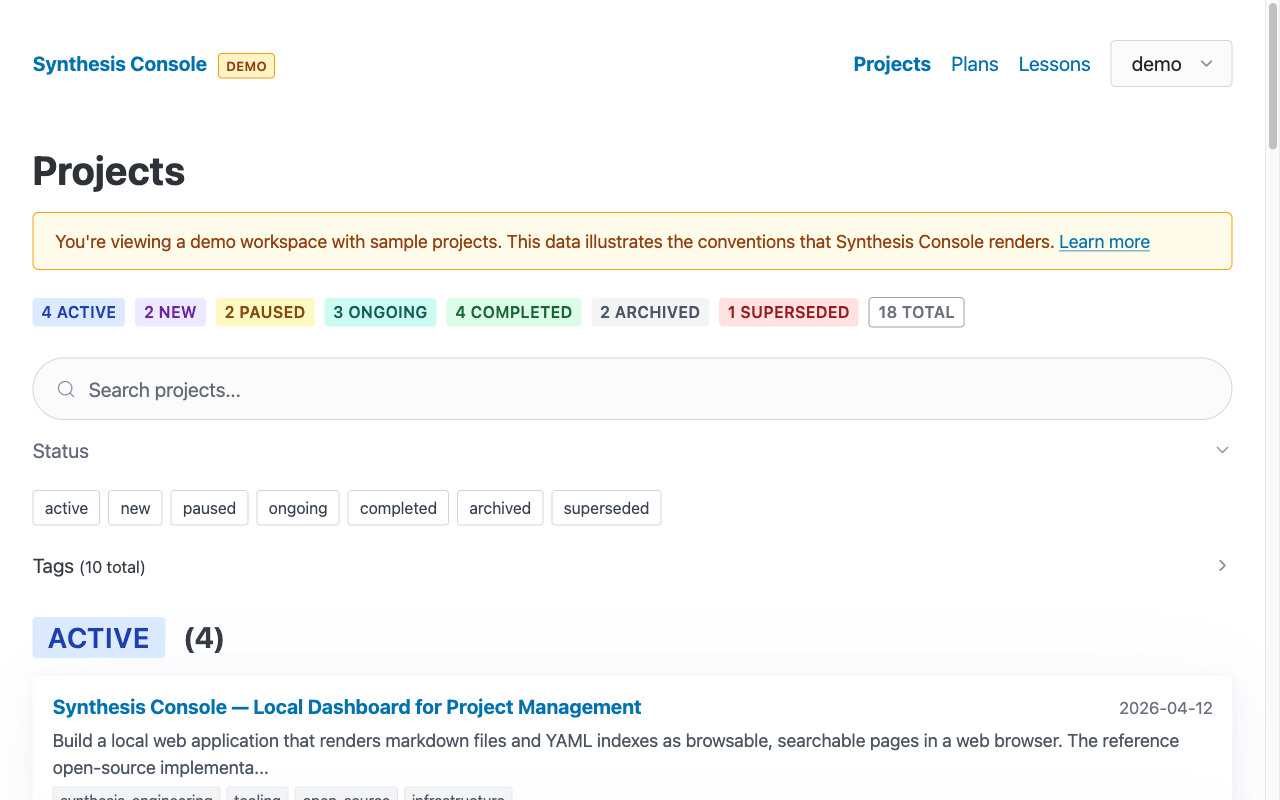
Demo mode as a pattern for software
Ship every software product with built-in demo mode. The pattern serves authors, users, sales teams, and compliance — and synthesis engineering makes it cheap e
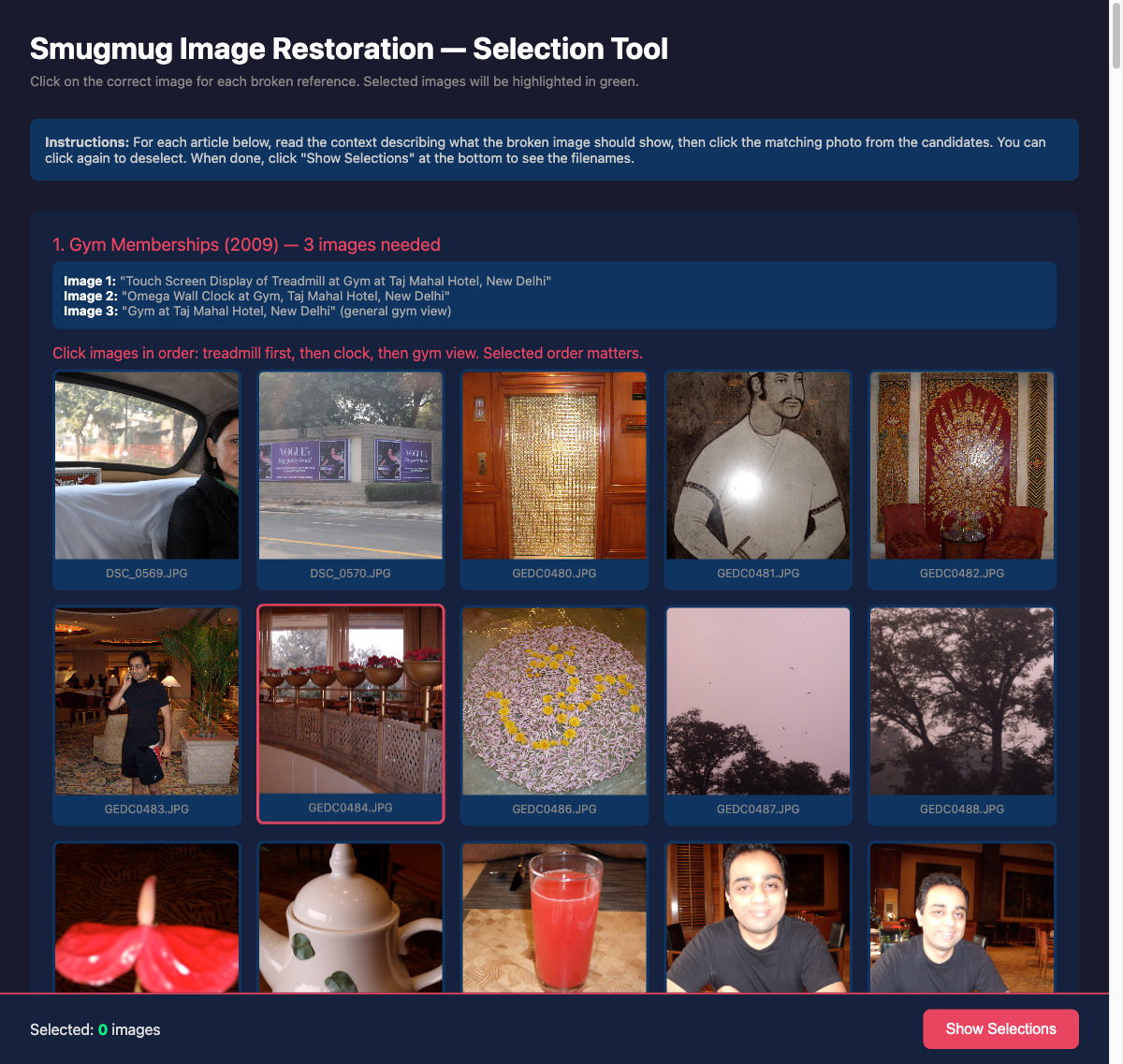
Restoring 16 Broken Blog Images Using AI, the Wayback Machine, and a 93GB Photo Backup
How I used Claude Code, the Wayback Machine, and AI vision to restore 16 broken images from a decommissioned Smugmug photo hosting service across 10 blog posts.
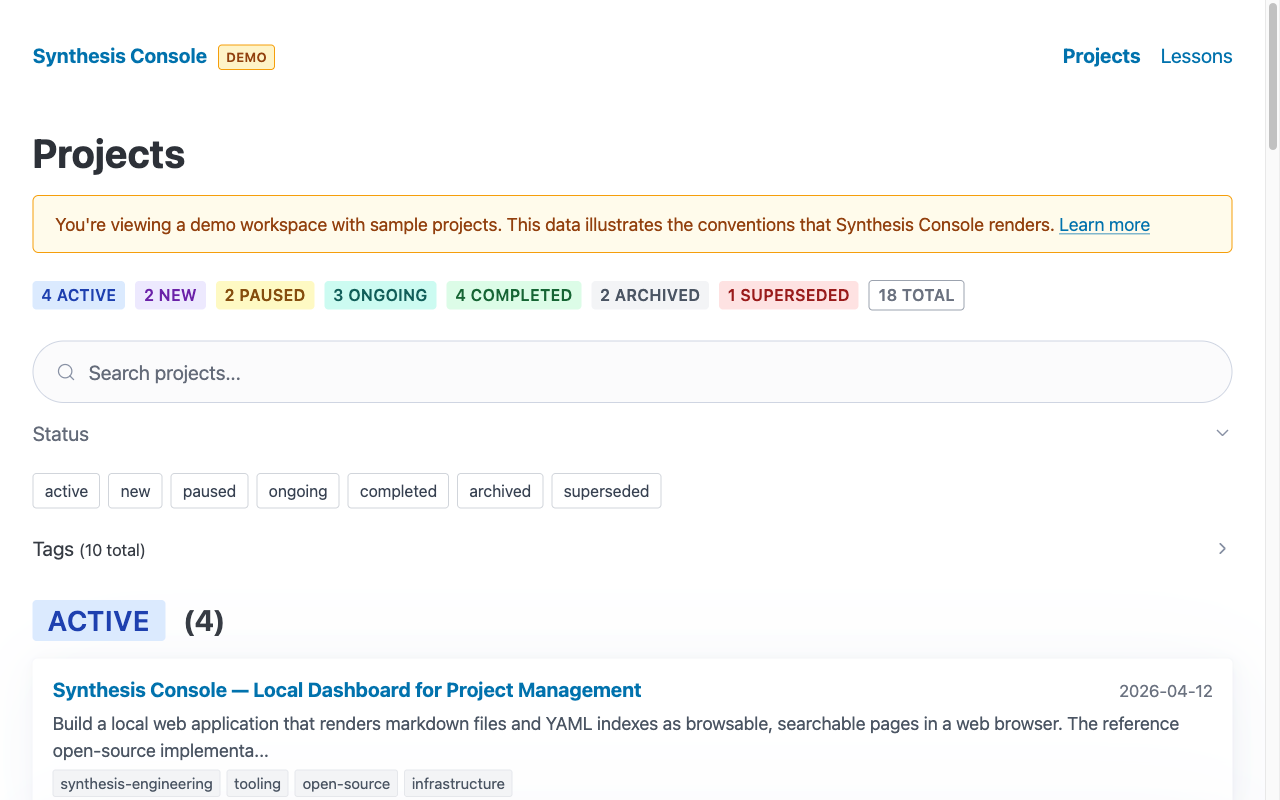
Synthesis Console: open-source tooling for synthesis engineering
An open-source local tool that renders project management markdown and YAML as browsable, searchable pages. Three dependencies, no client-side framework, and a
Transferable Knowledge: The Fifth Pillar of Synthesis Coding
You understand your AI-generated code. Can your teammates? Transferable Knowledge is the fifth pillar of synthesis coding -- ensuring AI-assisted work is compre
"All tests pass" is a warning, not a clearance
Why a green test suite after a schema change should trigger suspicion, not confidence. A verification methodology that catches what tests structurally cannot —
Stop asking me: configuring Claude Code permissions for uninterrupted flow
A practitioner guide to eliminating Claude Code approval prompt fatigue. Why granular command patterns fail for compound commands, the Bash(*) plus deny list ap
The blast radius principle: defensive patterns for AI-generated commands
Every command an AI assistant proposes has a blast radius: the worst it can do if wrong. Dangerous shapes, safer forms, and a three-tier safeguard hierarchy.
Managing AI agent skills at scale: a three-repo architecture
A three-repo architecture for managing public, private, and team AI agent skills with provenance tracking, drift detection, and synthesis merge — the first stan
Synthesis Skills: install methodology directly into your AI workflow
22 open-source Agent Skills encoding synthesis coding and synthesis engineering methodology. One command installs code review, content quality, project manageme
Synthesis merging: what happens after the first PR
Synthesis merging goes beyond conflict resolution. It is the creative act of integrating contributions into a coherent whole, making the combined result better
When a code review runbook becomes an upgrade playbook
I built a code review runbook to find problems. Then I used it on codebases I owned, and the review categories became execution phases. A checklist for assessme
What reviewing real codebases taught me about code review
I published a 900-check code review runbook. Then I used it on real engagements. The checklist worked, but the real lessons were about the process — starting wi
Recommend A, implement A: behavioral contracts for AI collaborators
My AI assistant argued for prevention, then implemented detection. Behavioral contracts in CLAUDE.md turn recommend-A-implement-B drift into a review comment.
When Someone Else Contributes to Your Synthesis-Coded Project
Standard merge workflows break down for synthesis-coded projects. The adopt-and-adapt pattern provides a disciplined integration methodology that respects contr
Never verify a result with the tool that produced it
Orthogonal verification for AI-assisted development: check results through a mechanism independent of the one that produced them, and at every pipeline stage.
The hidden lesson of Richard Socher's career: AI makes engineering discipline more valuable, not less
Richard Socher built the research that powers today's AI coding assistants and then described exactly how organizations should use them. His 'managers of AI' fr
Bidirectional Learning in Synthesis Coding: When Human and AI Teach Each Other
Bidirectional learning in synthesis coding: humans teach AI through context, prompts, and review; AI teaches back by surfacing blind spots and edge cases.
The research lineage from recursive neural networks to human-AI collaborative development
Tracing the intellectual thread from Richard Socher's compositional representations through DecaNLP to the systems-level engineering challenges of human-AI soft
From learned representations to engineered context: what Richard Socher's research tells us about working with AI
Richard Socher's research arc — from GloVe to DecaNLP to 'managers of AI' — maps directly onto the principles behind synthesis coding. The connections are struc
Code Review That Scales: An Open-Source Runbook for Agentic Engineering
Most code review checklists are either too shallow or too heavy. This open-source runbook tiers review depth by project complexity — and is designed for agentic
The Part of Your Job AI Can't Do (And Why It Matters More Now)
There's a lot of anxiety about AI making engineering skills obsolete. But the most valuable part of what you do was never the typing. The judgment, the architec
When Two Frameworks Point the Same Direction
LangChain published Agent Engineering on December 9. I'd been developing Synthesis Engineering since early November. We arrived at remarkably similar conclusion
RAG Architecture Lessons from Practice
Building a retrieval-augmented generation system revealed patterns the tutorials don't cover. Contractions break search. Not everything needs an LLM. Full docum
Data Format Contracts for AI Pipelines
When tools interact, implicit assumptions break silently. Explicit data format contracts prevent the debugging sessions you don't have time for.
Context Loss and How to Prevent It
Why AI assistants forget what you told them, and practical strategies to prevent it. The difference between context that survives and context that gets lost.
The Foundation-First Pattern
Why the most effective AI-assisted projects start with humans writing code by hand. The counterintuitive pattern that makes everything else work.
What is Synthesis Engineering?
Synthesis engineering is a professional discipline for human-AI collaboration on complex work. Not just better prompting — a systematic approach with princ...
How Claude's Memory Actually Works (And Why CLAUDE.md Matters)
Understanding Claude's context architecture changes how you work with it. The tradeoffs between automatic continuity and on-demand depth explain why persistent
What OpenAI's Sora Build Teaches Us About Synthesis Coding
Four engineers shipped a #1 Play Store app in 28 days using AI agents. Their approach validates the patterns I've been writing about — and adds new ones worth s
Cracking a 25-Year-Old Password with Claude Code
While cleaning up old files, I found a password-protected Word document from 1999. I had no memory of the password. Claude Code and I cracked it together.
Scaling Synthesis Coding in Your Organization
A practical guide for CTOs and engineering leaders: cost analysis, team rollout strategy, training curriculum, and metrics for adopting synthesis coding at s...
Building ownwords: A Synthesis Coding Case Study
What separates synthesis coding from vibe coding isn''t the tools — it''s the decisions. This technical case study walks through the architectural choices,...
Why Synthesis Coding Still Writes Code in the Age of LLMs
The answer is not "just let the model do it" — and code matters more, not less, as AI gets dramatically better Last spring, my son Fitz and I had an aftern...
Vibe Coding and Synthesis Coding: Two Complementary Approaches
Why the conversation isn''t about which approach is better — it''s about knowing when to use each This blog post is for software engineers, engineering lea...
Polyrepo Synthesis: Synthesis Coding Across Multiple Repositories with Claude Code in Visual Studio Code
I wrote this blog post for software engineers, architects, and technical leads. It is code-heavy and implementation-focused. This weekend I was working acr...
Seventeen years ago, I built a tool for the open Web. This weekend, I modernized it using Synthesis Coding with Claude Code AI
In 2008, I released a WordPress plugin called Blogroll Links. The plugin displayed lists of links on WordPress pages using a shortcode. But the idea behind...
The Self-Improving System: The Fourth Pillar of Synthesis Coding
Synthesis coding treats both the project and the practice as evolving systems. Iterative context building is one of four threads that compound together — alongs
Active System Understanding: The Third Pillar of Synthesis Coding
AI can generate code faster than you can read it. AI also removes the friction that used to force engineers to read carefully — which is why this pillar is the
Systematic Quality Standards: The Second Pillar of Synthesis Coding
AI-generated code should meet the same quality standards as human-written code — and in practice the bar should be higher, because AI scales the cost of letting
Human Architectural Authority: The First Pillar of Synthesis Coding
AI can write code faster than any human. But it cannot hold a consistent architectural vision across months of development. That is why the first pillar of synt
Synthesis Coding with Claude Code: Technical Implementation and Workflows
A hands-on guide to practicing synthesis coding (a.k.a. synthesis engineering) with concrete examples, real workflows, and lessons from production systems ...
The Synthesis Engineering Framework: How Organizations Build Production Software with AI
From individual practice to organizational capability: a systematic approach to human-AI collaboration in professional software development This blog post ...
Synthesis Engineering: The Professional Practice Emerging in AI-Assisted Development
Why the most effective engineering organizations are developing systematic approaches that go beyond vibe coding — and why this practice needs a name This ...
What Open Source Taught Me About Building Innovation
Open source is the most reliable engine of compounding innovation in software. The four properties that separate compounding projects from inert ones, and what
The Future of Engineering Services: Building and Measuring Human-AI Teams
Engineering services must shift from billing hours to delivering capabilities. New measurement frameworks, team structures, and pricing models for AI-augmented
The CTO and chief product officer in the Age of Generative AI: A New Playbook for Technology Leadership
How the CTO and chief product officer roles change in the generative AI era: from building to deciding what to build, from prioritizing to curating.