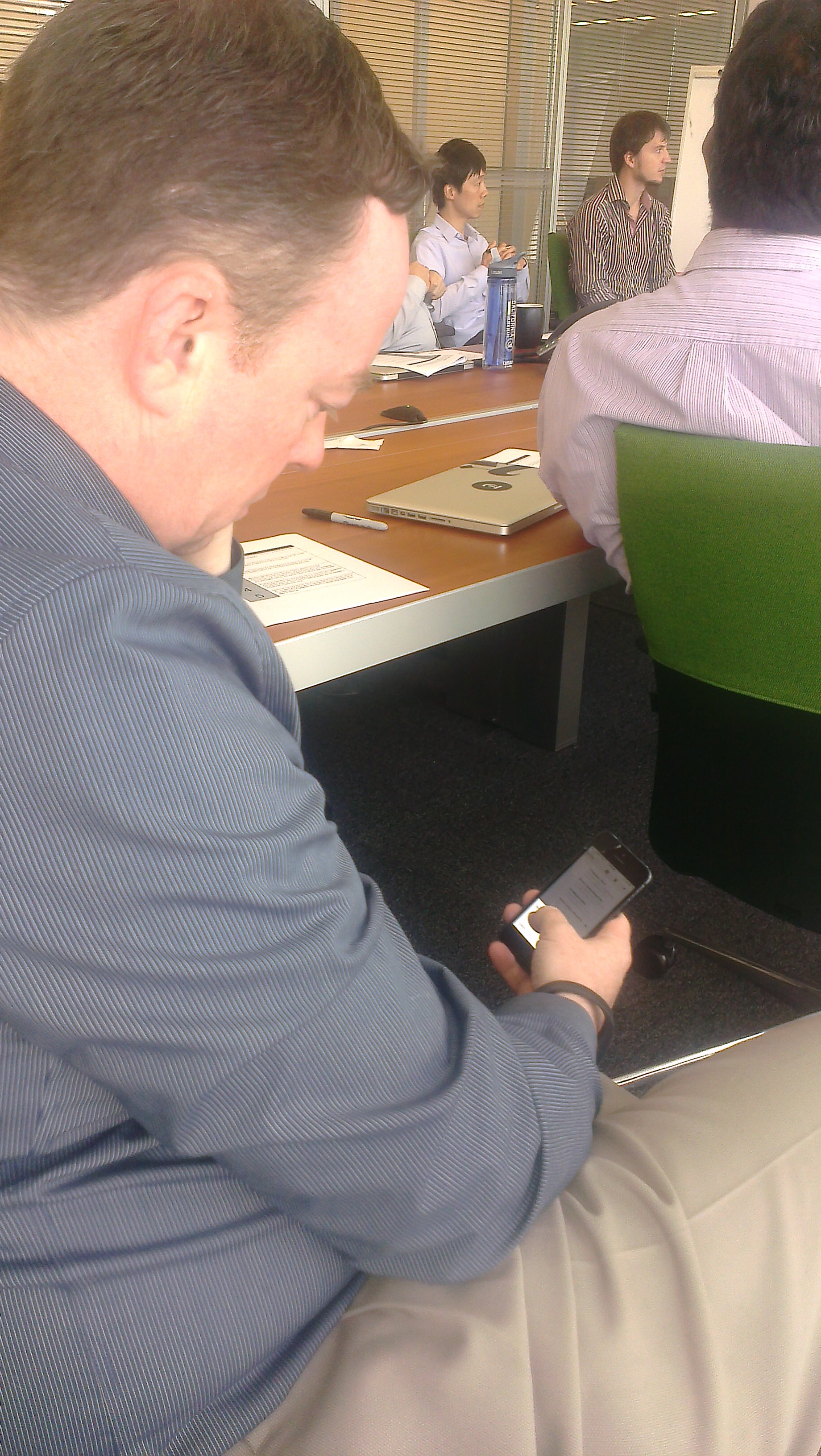
 You might think that no one is noticing when you are using your phone if you try to hide it below the table surface, but you’d be mistaken. It is like picking your nose: your being oblivious of others doesn’t make you invisible to them. Photo Credit: Brad Kagawa
You might think nobody notices when you sneak a look at your phone below the table during a meeting. You would be wrong. It is like picking your nose: your being oblivious of others does not make you invisible to them.
Using smartphones (or worse, laptops) during in-person meetings diminishes productivity, is disrespectful to others, and decreases your brainpower. Scientific evidence indicates that multitasking makes people less intelligent.1 When you are doing something unrelated on your phone or laptop during a business meeting, you lose out because you become oblivious to the environment, people, and subtleties around you.
I run and attend a lot of meetings. As CTO of The New York Times, I oversee an organization of hundreds of people, which means dozens of meetings every week. I have watched the device problem get worse year by year. People check their phones under the table. Others bring laptops and type away, ostensibly taking notes, but you can tell by the rhythm of their keystrokes and the flickering reflections in their glasses that they are reading email. The meeting suffers. The person suffers. Everyone knows it, and nobody says anything.
That silence is the real problem.
When devices make sense
There are a few situations where using a laptop or smartphone during a meeting is reasonable.
The most obvious: when you are the designated note-taker. Taking notes on a computer saves time, is more accurate than writing on paper and digitizing later, and the results can be searched, shared immediately, and stored securely. Paper notes pile up, cannot be easily searched, and can be left behind where someone without authorization might read them. One rule worth enforcing: there should be only one note-taker per meeting. If it is a negotiation between two sides, no more than one per side.
It also makes sense to use a device when you need to quickly look up something relevant to the discussion in progress, or to capture an action item in your task manager so you can return your full attention to the conversation. And sometimes, discreetly asking a question or sharing information via instant message is genuinely less disruptive than speaking up in a large group.
Tip: When you bring a laptop to a group meeting or one-on-one meeting, respectfully explain to the others beforehand that you will use it for taking notes and recording action items only. Make it clear that your attention is on the discussion and the laptop is simply your digital notepad.
When they don’t
In most situations, the drawbacks far outweigh the benefits.
It comes across as disrespectful to other attendees, especially those who grew up in a world where you gave the people in the room your full attention. The laptop screen creates a physical wall between you and the people sitting across from you. And the device makes it easy to drift into email or other online distractions. (A tablet like the iPad that lies flat on the table like a writing pad has less of this problem, since it does not create that visual barrier.)
After all, even a person using pen and paper can be distracted doodling or daydreaming. But a connected device makes distraction effortless and constant, and that is the difference.
Tip: At the start of your meeting, announce that if anyone needs to use their phone or laptop, they should step out of the room, use their device outside, and return when done. This gives attendees the freedom to handle something urgent without disrupting everyone else.
What I do
In my own meetings, I have found that the simplest intervention works best: name the problem openly. When people know that device use in meetings is noticed and discussed, the behavior changes. It does not require a policy document. It requires a culture where people respect each other’s time enough to actually be present.
One small, practical thing: provide a mobile phone charging area in your meeting rooms. It gives people a graceful reason to put their phone down and participate fully.
The core issue is not really about devices. It is about whether the people in the room have decided to actually be in the room.
Footnotes
-
The High Cost of Multitasking: https://blog.fuze.com/the-high-cost-of-multitasking-infographic/ ↩