I’m leaving Condé Nast this month after four years as VP of Digital Technology, overseeing the Condé Nast brand sites and Reddit. Soon I start at The New York Times. Before I go, I want to capture some of what we built here.
The scope
When I arrived in June 2007, I inherited responsibility for 65+ websites, including Wired.com, GQ.com, Vogue.com, NewYorker.com, Style.com, Epicurious.com, VanityFair.com, Glamour.com, and Brides.com. By the time I left, we’d launched or redesigned most of them. The sites won several industry awards each year for relaunches and redesigns where the technology work was done by my teams.
I reported to the President of Condé Nast Digital, the COO, and the corporate CIO & CTO through various organizational changes over the years. The budget ran into the tens of millions annually.
The team grew to over 80 people across multiple departments: Software Engineering, Technology Operations, Technical Analysis & Quality Assurance. We had staff in New York City, San Francisco, and Wilmington, Delaware, plus offshore teams in India, Singapore, and Russia. The Condé Nast brand sites served 28-35 million monthly unique visitors.
The Reddit engineering team reported to me: Steve Huffman, Chris Slowe, and Jeremy Edberg. Alexis Ohanian, who co-founded Reddit with Steve, handled community and marketing.
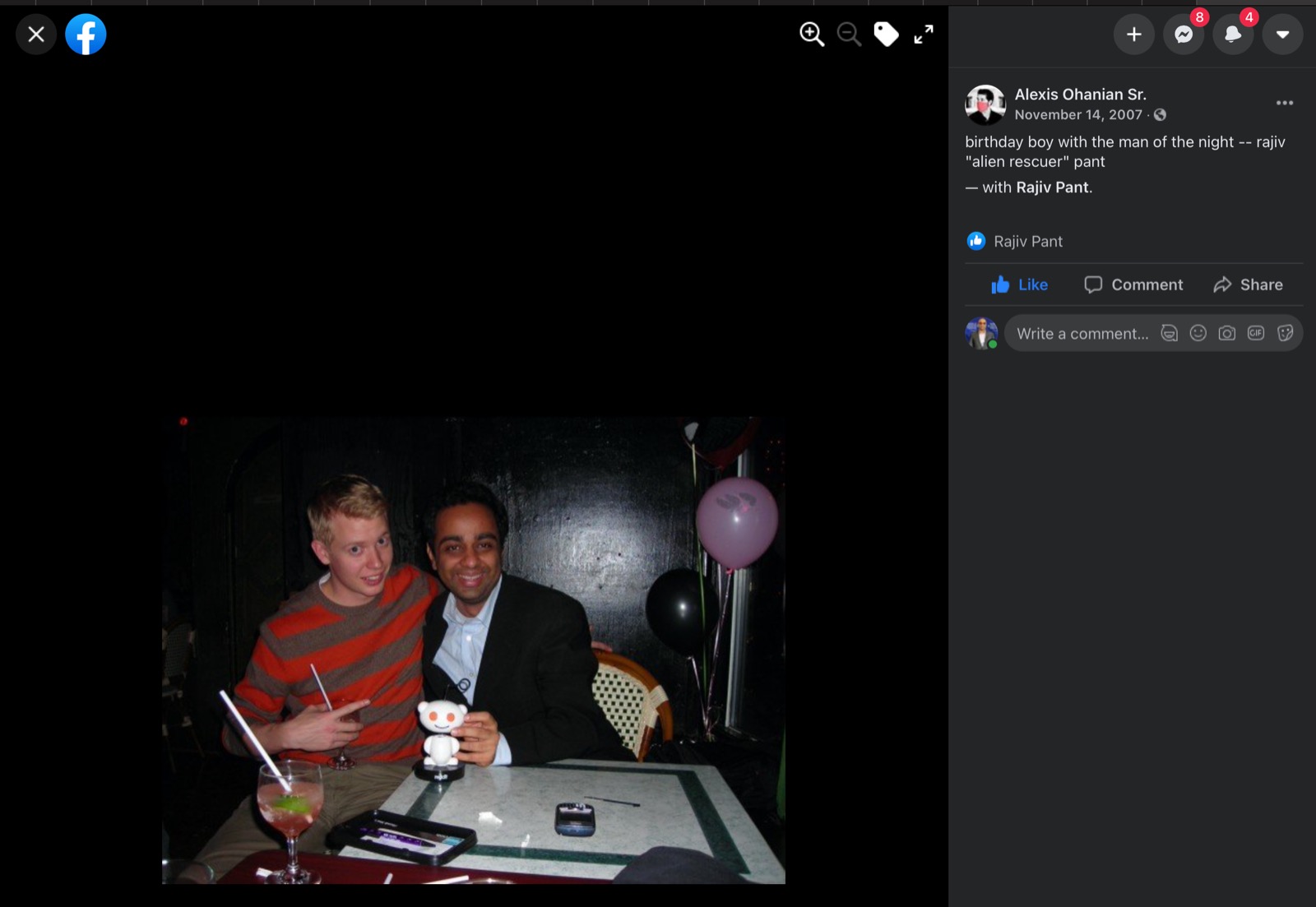 Alexis Ohanian’s Facebook post from November 14, 2007, where he nicknamed me the “alien rescuer”
We open-sourced the Reddit codebase in June 2008, which was unusual for a corporate-owned site at the time. The team built a robust API that let the community create their own mobile apps. They kept the infrastructure stable through rapid growth. Those decisions paid off during the Digg exodus in 2010, when millions of users flooded Reddit and the servers held.
By May 2011, Reddit was serving over 1.2 billion monthly page views. That was an education in what a talented team can accomplish.
The mobile moment
The work I’m proudest of happened on mobile. In 2010, we built the Epicurious Recipes & Shopping List app for iPhone. It lets you browse recipes, save favorites, and generate shopping lists automatically.
Last June, Steve Jobs featured our app in his iPhone 4 keynote. Showed it on the big screen at WWDC. Apple used it in their advertising afterward.
That was a good day.
We built a lot of other mobile apps too. Apps we developed directly: GQ, Vanity Fair, and Glamour for iPad and iPhone; Wired Product Reviews; the Style app; Concierge Postcard. Apps we collaborated on with Adobe’s digital magazine platform: Golf Digest Hot List, Condé Nast Traveler Cruise Finder, Condé Nast Traveler Hot List, various Vogue apps. Plus Gourmet Live and The New Yorker’s Goings On About Town.
I encouraged teams to quickly learn emerging technologies (iPhone and Facebook app development) and develop award-winning applications that received praise in press and were featured on Apple’s web sites and Apple Store billboards. Our Social Networking Team produced more than 20 applications in less than one year and presented them at conferences receiving praise for the quality and rapid development.
Mobile went from zero to a major focus of the organization in about two years. The trajectory was obvious once the iPhone launched. The question was how fast we could execute.
Infrastructure
Less glamorous than apps, but maybe more impactful: we rebuilt the infrastructure.
When I arrived, we were running on expensive Sun/Solaris systems with proprietary software. Hosting costs were high. Scaling was painful.
We migrated to commodity Intel/Linux. Moved from expensive proprietary Java application servers to economical open source ones. Virtualized the data center into a private cloud solution. Introduced Amazon EC2 (first at the company to use it). We also introduced a balanced diversity of technologies and rapid development tools like PHP and Grails to complement enterprise Java and Oracle.
The savings were substantial. Over 50% reduction in hosting costs, which translated to millions annually. We renegotiated our CDN contract, another 50%+ savings. Same with our community functionality vendor, hundreds of thousands in annual savings.
I’m not going to pretend this work was exciting. But it freed up budget for the stuff that was.
The savings mattered because they meant we didn’t have to cut as deep elsewhere. Every dollar we saved on hosting was a dollar we didn’t have to take from the team. Infrastructure efficiency wasn’t just about the balance sheet. It was about protecting people’s jobs.
We also led teams to solve stability and performance issues on web sites and content management systems. And we instituted 24x7 Internal Customer Service & Help Desk for all our web production staff.
The team
I went through two difficult downsizings during my time here. Most managers treat layoffs as an unpleasant task to get through. I couldn’t do that.
One of my deeply held beliefs is that paid work gives people dignity. Losing a job isn’t just a financial setback; it affects how people see themselves. I offered to give up my annual bonus if it meant keeping one more person employed. The offer wasn’t taken (the numbers didn’t work that way), but I meant it.
When layoffs were unavoidable, I did everything I could to help people land somewhere. I made personal phone calls on evenings and weekends, connecting people with hiring managers I knew, writing recommendations, making introductions. It wasn’t part of my job description. It was just the right thing to do.
Some of those people came back to work for me later: at Condé Nast, and at subsequent jobs. Many of them are still friends today. That matters more to me than any efficiency metric.
We also successfully integrated teams that previously reported into different organizations. We did this twice in two separate mergers of external technology departments into my team. Neither was simple.
What I tried to do: be direct, be fair, make decisions quickly, and give people clarity about where they stood. I don’t know if I always succeeded. I tried.
The integration work involved uniting disparate cultures and product lines resulting from mergers. We improved management visibility into the software development process by growing agile project management methodologies throughout the organization. We integrated back-end and front-end development teams into one coherent organization. Streamlined QA teams and processes, including the introduction of automated testing to complement manual testing. Created efficiencies by eliminating boundaries between different departments. Created an environment of learning and sharing. Expanded the skills of individual engineers. Adapted ‘generalist’ and ‘specialist’ models to meet different types of business needs.
We retained staff in difficult times. All the employees who had been laid off found jobs elsewhere within a few months. A number of them later resigned from those jobs to come back and work on my team when we were hiring again.
The good part was building. One of my engineers won Condé Nast’s 2009 Innovator of the Year award. That meant something to me. You can tell a lot about an organization by whether the people doing the work get recognized.
We moved from remote development environments to Mac-based local development, which sounds like a small thing but made a real difference in productivity. Engineers could actually see what they were building. We gained additional days worth of work per month for each engineer.
I also co-authored a process for project management and communication system for all departments and the executive team. And I led technology due-diligence for investments and acquisitions, plus integration and ongoing operations post acquisitions/mergers.
What worked
Bet on mobile early. We started building iPhone apps before it was obvious that mobile would matter this much. That bet paid off.
Fix the foundation. The infrastructure work wasn’t sexy, but it gave us the room to build. You can’t do interesting things on top of a shaky base.
Hire people who care. The best engineers I worked with weren’t just technically skilled—they cared about the products and the users. That combination is rare.
Ship constantly. We launched a lot of websites, apps, and features over four years. Not all of them succeeded. But the ones that worked made up for the ones that didn’t.
What didn’t
Organizational complexity. Condé Nast is a federation of powerful brands. Getting alignment across them is hard. Sometimes we moved slower than we should have.
Legacy systems. Some of what we inherited was difficult to work with. We made progress, but there’s still work to do.
Timing. Some products we built were ahead of their time. Some were behind. Getting timing right is harder than it looks.
What’s next
The New York Times. Different challenges, different scale, different expectations. I’m looking forward to it.
Condé Nast taught me how to work with creative organizations, how to bridge the gap between technology and editorial, between engineers and editors. Those lessons will transfer.
Looking back, the hardest parts weren’t the technical challenges. They were the human ones. Building systems is straightforward compared to building trust, navigating layoffs with integrity, or helping people grow. The technology I built will eventually be replaced. The relationships won’t.
Four years is a good run. Time to go build something new at The New York Times.